Does your office say anything about who you are?
The short answer. Most offices could belong to anyone. Yours says something about your business whether you plan it or not, through the entry, the layout and the materials. The offices that get this right start with how the team actually works, and let that shape every decision.
Most people don’t think of their office as something that communicates, but it does. The layout, the materials and what you see when you walk in all say something about the business before anyone has said a word, and the real question is whether it’s saying the right thing.
Walk into a lot of offices and you could be anywhere: the same furniture, the same layout and nothing that tells you about the people who work there. The offices we’re proudest of aren’t necessarily the most expensive ones. They’re the ones where the business was clear about what it stands for, and we let that shape the materials, the layout and the first thing you see when you walk in the door.
It starts with understanding how you actually work
Before we talk about colours or furniture, we ask one question: how does your team actually spend its day?
A business built on collaboration needs different spaces from one built on focused, heads-down work. A firm that has clients in every day needs a different entry from one where visitors are rare. Those are business decisions first, and the design should follow them. Get them right early and every choice after that has a reason behind it. Skip them, and you can end up with a space that looks great in photos but never quite feels right to work in.
What does your entry say before anyone speaks?
The entry and reception are the first thing a visitor sees and often the thing they remember, so they carry more weight than their square metres suggest. At MSS Security in Port Melbourne, the entry is built around the company’s 129-year history, so anyone walking in learns something real about the business before they’ve reached the front desk.
How does the layout say how a business works?
Layout tells people how a business runs: how many meeting rooms there are and where they sit, whether leaders sit out on the floor, whether there’s anywhere to concentrate, and where the team eats lunch. People pick up on these things long before they could put them into words. A floor full of enclosed rooms and a floor built around open collaboration say different things about privacy and how decisions get made, whether anyone meant them to or not.
The details do the talking
You don’t need a logo on every wall to make a space feel like yours. In fact, the most distinctive offices we’ve worked on barely mention the brand at all.
It comes through in subtler ways: the warmth of the materials, whether the space feels open or carefully considered, and whether there’s somewhere to have a private conversation or everything happens in full view. Choices like these say more about a business’s values than signage does.
What does professional with personality look like?
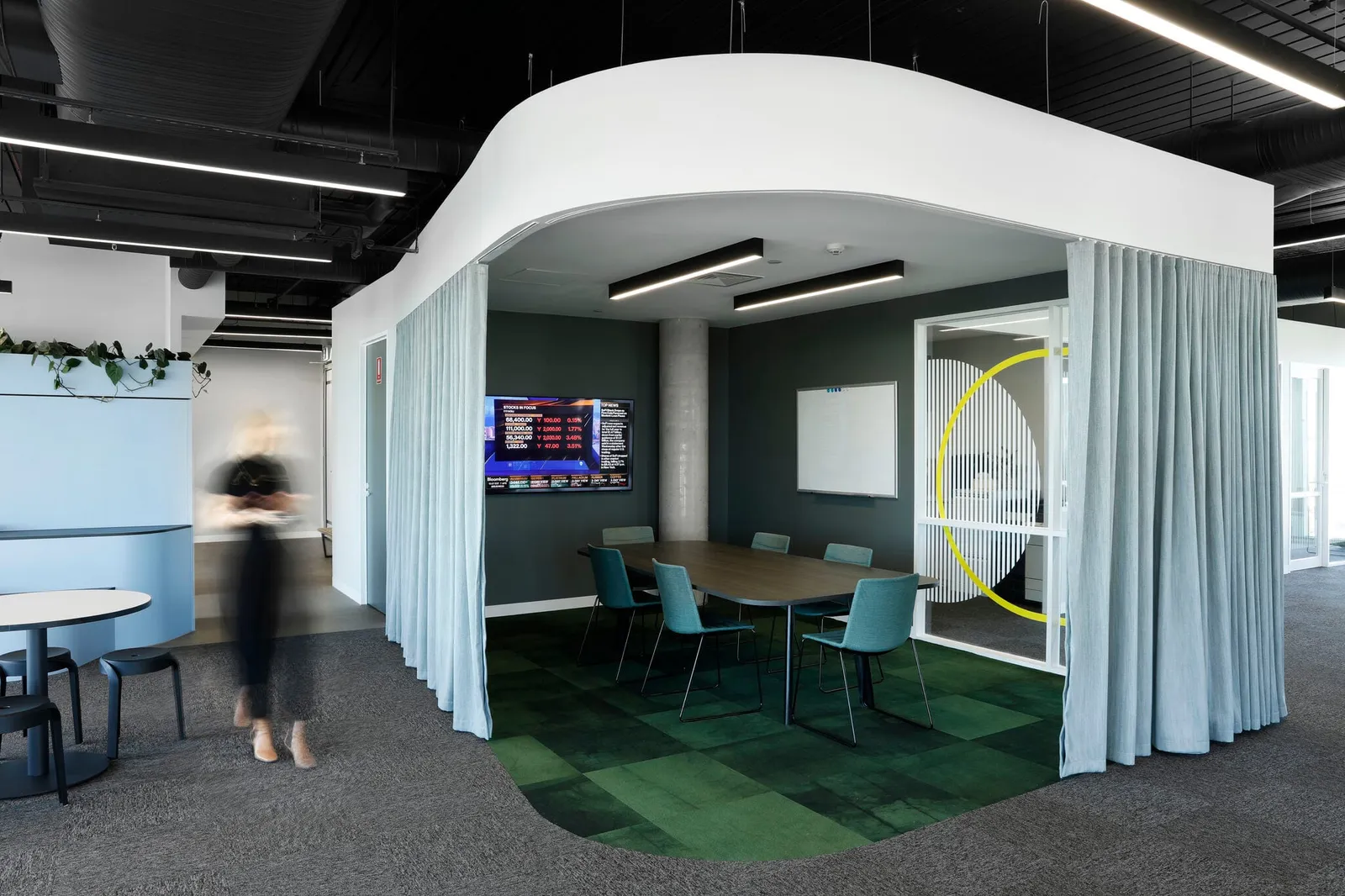
It rarely means a gimmick. Interchange’s office in Collingwood is professional without being generic, with warm timber, bold joinery colours and a black exposed ceiling. Vudoo’s office, also in Collingwood, was designed to give a mostly remote team a reason to come in, with bold colour, greenery and a meeting room wrapped in a curved wall and curtains. Neither could be mistaken for anyone else’s office. Our post on designing an office for hybrid work covers how to plan for a team like that.
Colour doesn’t have to mean every wall. One confident move, like a curved room, a feature wall or a run of coloured joinery, often does more than a palette spread thinly across the whole floor.
A 30 minute test for your own office
Try this: walk in the way a visitor would, through the front door and past reception, and write down five words for the impression you get. Ask three people who work there to do the same without comparing notes. Then photograph the entry, the kitchen and the quietest spot you can find, and look at them side by side.
If the words and the photos don’t match what you’d say about your business, you’ve found where to start. Our post on meeting rooms, boardrooms and breakout areas is a good next read if the kitchen or the meeting rooms are where it falls down.
Worth thinking about
If someone walked into your office for the first time with no idea what your company does, what would they conclude? If the answer is “not much”, that’s a good conversation to start with.
If you’d like to talk it through, feel free to reach out. You can also see our recent projects and what we do.
Frequently asked questions
Can office design reflect company culture?
Yes. Layout, materials and the entry all say something about how a business works, whether or not it was planned. The aim is to make those choices on purpose, starting from how your team actually spends its day.
Do I need my logo on the walls?
No. In our experience the best branded offices barely reference the brand explicitly. Warm materials, how open or considered the space feels, and having somewhere private to talk reflect values more honestly than signage.
Where should I start if my office feels generic?
Start with how your team works, before colours and furniture. Then look at the entry, the kitchen and the quietest space, and ask whether they say anything about your business.


